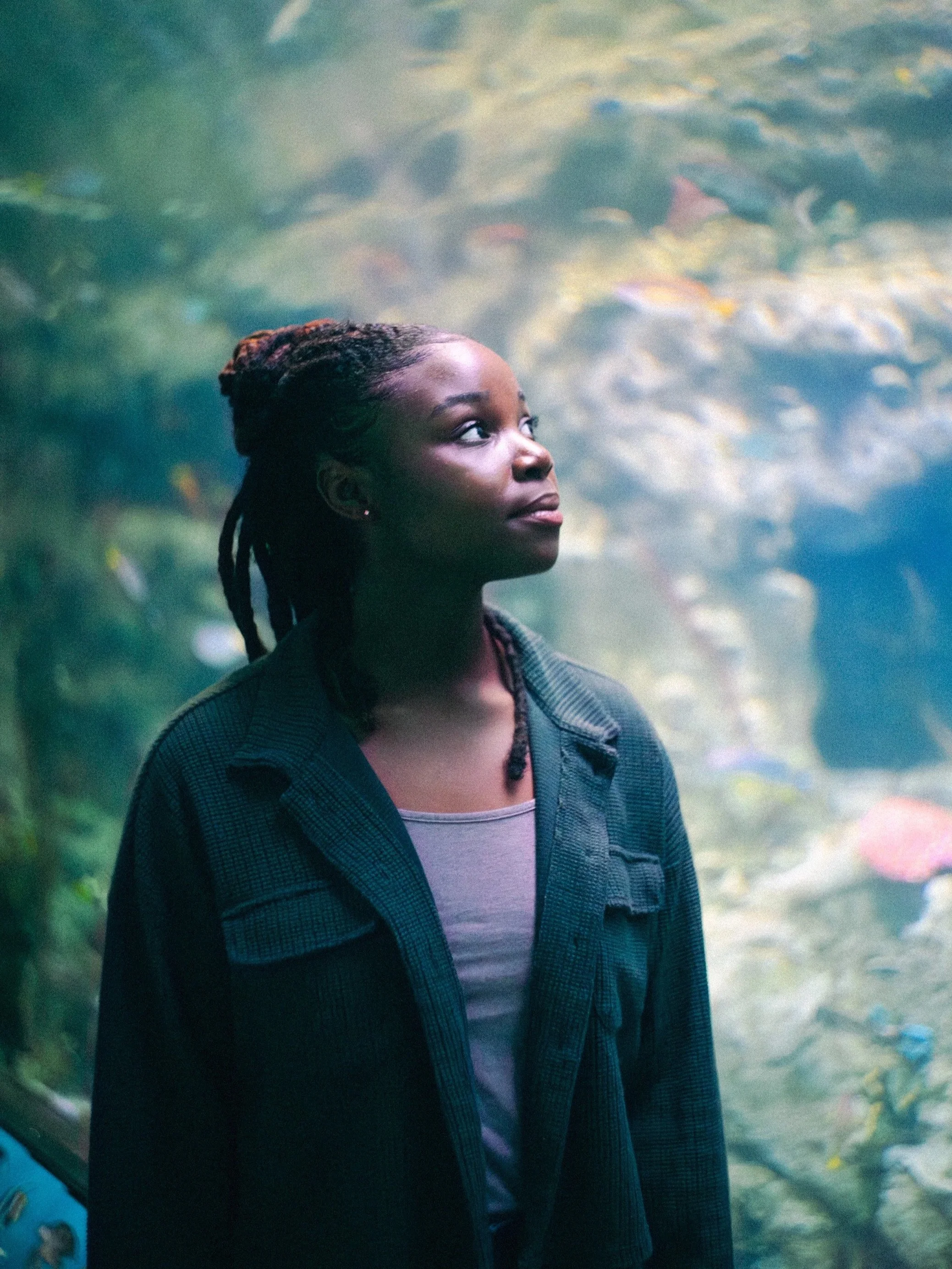
Pa-Shun Hawkins
Graduate Student Researcher
What inspired your connection to the ocean and led you to pursue a career in marine science?
I didn't grow up knowing marine science was an actual career path people pursued. When I applied to college, I didn't want to go in as undecided, so I randomly chose programs that piqued my interest. Ultimately, I chose Hampton University where I joined their Marine and Environmental Science (MES) program. Once there, I quickly realized it wouldn't be easy; the program was known for its rigor. Nonetheless, I was very competitive, and I decided to step up to the challenge.
At Hampton, we had amazing guidance from our department chair and the MES faculty. We had immersion in the field, on land, and out on the Chesapeake Bay. I fell in love with the adventure, Virginia’s beauty, and the connection to nature. I also fell in love with asking questions and building solutions in a supportive community.
My favorite part was nature journaling: slowing down to study the fine details of things like fish, crabs, snails, and sponges--identifying and sketching everything. Also, sitting on Hampton’s waterfront, coloring with colored pencils while watching seabirds and tiny periwinkles. It felt like the world paused during those moments. I loved being on the boats, too--genuinely excited by whatever we trawled up and brought back to the MES aquarium.
I didn’t even like the outdoors before this program, but I left as a scientific diver and a true nature enthusiast. That combination of rigor, adventure, and belonging is what inspired my connection to the ocean and made me continue a career in marine science.
Tell me about the specific research or work you’re currently focused on and why it’s important?
My current research sits at the intersection of microbial ecology, history, and critical ecology. I study how historical systems of power, particularly colonial plantation agriculture, have shaped ecological processes that persist today. Specifically, I examine how plantation disturbance intensity influences soil microbial community assembly, ecosystem multifunctionality, and biogeochemical cycling in secondary tropical forests on St. Croix.
This work is part of a broader effort to understand how infrastructures of power like colonial land-use systems, leave measurable ecological legacies. While humans are among the most significant drivers of environmental change, the social and political dimensions of disturbance are often under-quantified in ecological research— especially disturbance that took place centuries ago. My work aims to bridge that gap by linking historical land-use intensity to present-day microbial communities and the ecological legacies they sustain.
How does the location where we shot hold significance for you and/or your work?
I'm part of the Aquarium of the Pacific's CELP Scholars Program (Community, Equity, Learning, and Persistence Scholar Program) in the most recent cohort. The program focuses on increasing participation in marine science, building community in STEM, and supporting students' persistence. So far, I've connected with local marine professionals, who have been welcoming and affirming, and I've presented my journey into STEM to high school students.
Most recently, I served on the aquarium’s graduate student panel where I spoke with scholars who were deciding whether to attend graduate school immediately or take a gap year. I shared my experience transitioning directly from an HBCU to a PWI for my Ph.D., and reflected on lessons I’ve learned about managing burnout and navigating new institutional cultures.
It was incredibly meaningful to provide perspective as someone who has recently navigated those decisions, while also learning from fellow panelists who chose different paths like entering the workforce or pursuing a master’s degree. It reminded me how common and important these questions are each year, and how valuable it is for students from similar backgrounds as mine to receive guidance early.
Beyond the panel, I’ve proposed mentorship programming ideas to the Aquarium and received feedback from senior scholars on how to refine them. That experience helped me better understand how to structure a proposal, communicate impact, and collaborate across cohorts.
What are your thoughts on the potential cuts to NOAA funding, and how do you think it might impact your work and the broader field of marine science?
I am very disappointed in the funding cuts. In grade school we were encouraged to pursue STEM, ask questions, and create. Cutting federal marine research funding feels like a reversal of that push for STEM and a dismissal of the value of basic science — the foundation behind so many breakthroughs. For my work and others, funding cuts ended and paused grants, provided less support for fieldwork, lost long term datasets, and made it difficult to ask certain environmental and climate related questions. For the broader field it also narrows who participates in marine science. It’s a step backward at a time when environmental crises are very real and protections people fought for are at risk.
What does it mean for Black people to have access to and to be represented in this field?
For Black people, access to marine science gives us a chance to be a part of important decisions concerning our planet. It means our communities aren't overlooked and can be protected. Additionally, our identities inform the questions we are interested in; questions other groups of people might miss or deem unimportant, so our being in the field expands what science notices and values.
My path in marine science was possible because Hampton offered a Marine Science program; if they hadn't, I would not be living this version of life. That’s why representation matters. Our involvement creates pipelines. Those who make it in the field are more likely to return to their communities, mentor, and bring more people to the table. No one should feel limited by who they are or miss out on an amazing career because they didn’t see it modeled.