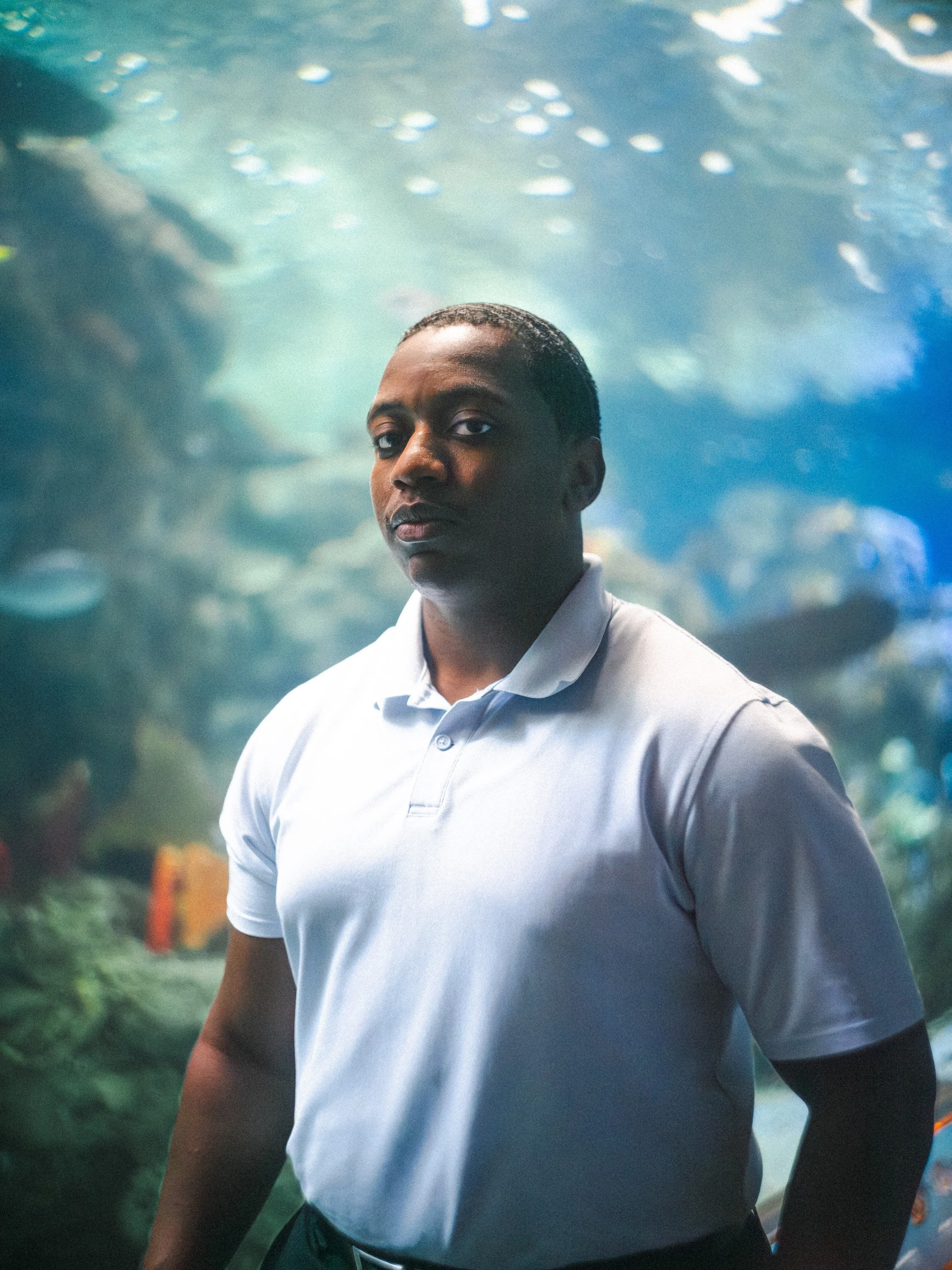
Derrick Richardson,
Graduate Marine Researcher
What inspired your connection to the ocean and led you to pursue a career in marine science?
Growing up in Lithonia, Georgia, where opportunities were often limited and science was undervalued, my passion for the ocean was sparked by Saturday mornings watching Animal Planet. These early glimpses into the natural world offered an escape from an under-resourced school system and a community facing systemic challenges. Balancing full-time work at McDonald’s during high school to support my family, I found strength and direction through music, which ultimately led me to Hampton University on a band scholarship. There, I majored in Marine and Environmental Sciences, finally engaging hands-on with the world that once existed only on a screen. Now pursuing a PhD in Marine Science at UCLA as the only African American in my department, I am driven by a deep-rooted curiosity and a commitment to representation, perseverance, and inspiring others from underrepresented backgrounds to find their path in science.
Tell me about the specific research or work you’re currently focused on and why it’s important?
My current research focuses on understanding the long-term changes in fish biomass by analyzing the relative impacts of fishing pressure and environmental change. Fish biomass from exploited stocks has historically declined due to overfishing, but recent evidence highlights the growing role of ocean warming in shaping these trends. To assess the sensitivity of fish biomass to both drivers, I use the BOATS (BiOeconomic mArine Trophic Size-spectrum) model, which simulates global fish biomass variation across species size classes and functional groups using historical catch reconstructions, primary production, and temperature data. By comparing these simulations to observational biomass trends from the RAM Legacy Stock Assessment database, I can identify patterns in how dif erent marine ecosystems—especially Large Marine Ecosystems (LMEs)—respond to fishing and climate stressors. This research is critical for improving our understanding of the resilience of marine ecosystems and supporting more ef ective, data-driven fisheries management and conservation strategies.
How does the location where we shot hold significance for you and/or your work?
At the Aquarium of the Pacific, I’ve had the privilege of participating in the Community Engagement and Leadership Program (CELP), which supports students from underrepresented backgrounds in marine science. Through CELP, I gained hands-on experience in science communication, public engagement, and conservation advocacy. My journey there allowed me to connect with a diverse group of scholars and mentors who share a passion for ocean education and community impact. I helped develop outreach initiatives aimed at making marine science more accessible to underserved communities, and led public presentations on ocean sustainability. Being part of CELP not only strengthened my leadership and communication skills, but also deepened my commitment to using marine science as a tool for equity and education.
What are your thoughts on the potential cuts to NOAA funding, and how do you think it might impact your work and the broader field of marine science?
Cuts to federal marine research funding pose a serious threat to the progress and sustainability of marine science. Much of our work—especially long-term ecosystem monitoring, climate modeling, and fisheries assessment—relies on consistent federal support. A reduction in funding would limit access to critical datasets, restrict research opportunities for early-career scientists like myself, and slow the development of tools needed to address climate change and biodiversity loss. For projects like mine, which depend on high-quality data and computational resources to model fish biomass trends, these cuts could hinder both accuracy and impact. More broadly, it risks setting back national and global efforts to ensure ocean health and food security.
What does it mean for Black people to have access to and to be represented in this field?
Representation in marine science is not just about visibility—it is about equity, access, and reshaping the culture of science itself. For Black communities, having access to this field means confronting historical barriers while building new pathways for engagement, education, and leadership. When Black scientists are empowered and supported, it challenges systemic exclusion and brings diverse perspectives that enrich science. Representation also matters deeply for young people—seeing someone who looks like them thriving in marine science can spark curiosity, confidence, and a belief that they, too, belong. Expanding access is essential not only for justice but for the innovation and resilience of the entire field.